Where Should an Indian Founder Incorporate? US vs UK vs Singapore vs UAE (2026)
US, UK, Singapore or UAE? A plain comparison for Indian founders with 2026 government fees, tax rates, director rules and the India-side ODI, LRS and TCS rules.
Last updated 25 October 2026 · By Paras Jain · Not legal or tax advice
There's no single best country. Choose the US if your customers, payment processor or investors are American. Choose Singapore if you're building for Asia and need a regional holding company. Choose the UK for a low-cost company that sells to UK and European clients. Choose the UAE if you will actually live or run the business there. Whichever you pick, a founder living in India is making an overseas investment, so the India-side rules apply first.
Below is the comparison we wish founders had before they spent money, with every fee and rate linked to the government page it comes from.
Incorple forms US companies only. The UK, Singapore and UAE sections are here to help you compare, not to sell you a formation.
The quick verdict by founder type
Start with who pays you and where you'll live. Those two answers settle most of the decision.
| If you are | Look at first | Why |
|---|---|---|
| A SaaS founder selling to US customers | US (Delaware or Wyoming LLC, or a Delaware C-Corp) | US customers, Stripe and US banks expect a US company |
| Planning to raise from US venture capital | US (Delaware C-Corp) | Most US investors expect a Delaware C-Corp |
| A B2B founder selling across Southeast Asia | Singapore | Regional credibility, but you need a resident director |
| An agency or freelancer with UK or EU clients | UK | £100 to register online and directors don't need to live in the UK |
| Moving to Dubai or running operations there | UAE | Makes sense when the business genuinely operates in the UAE |
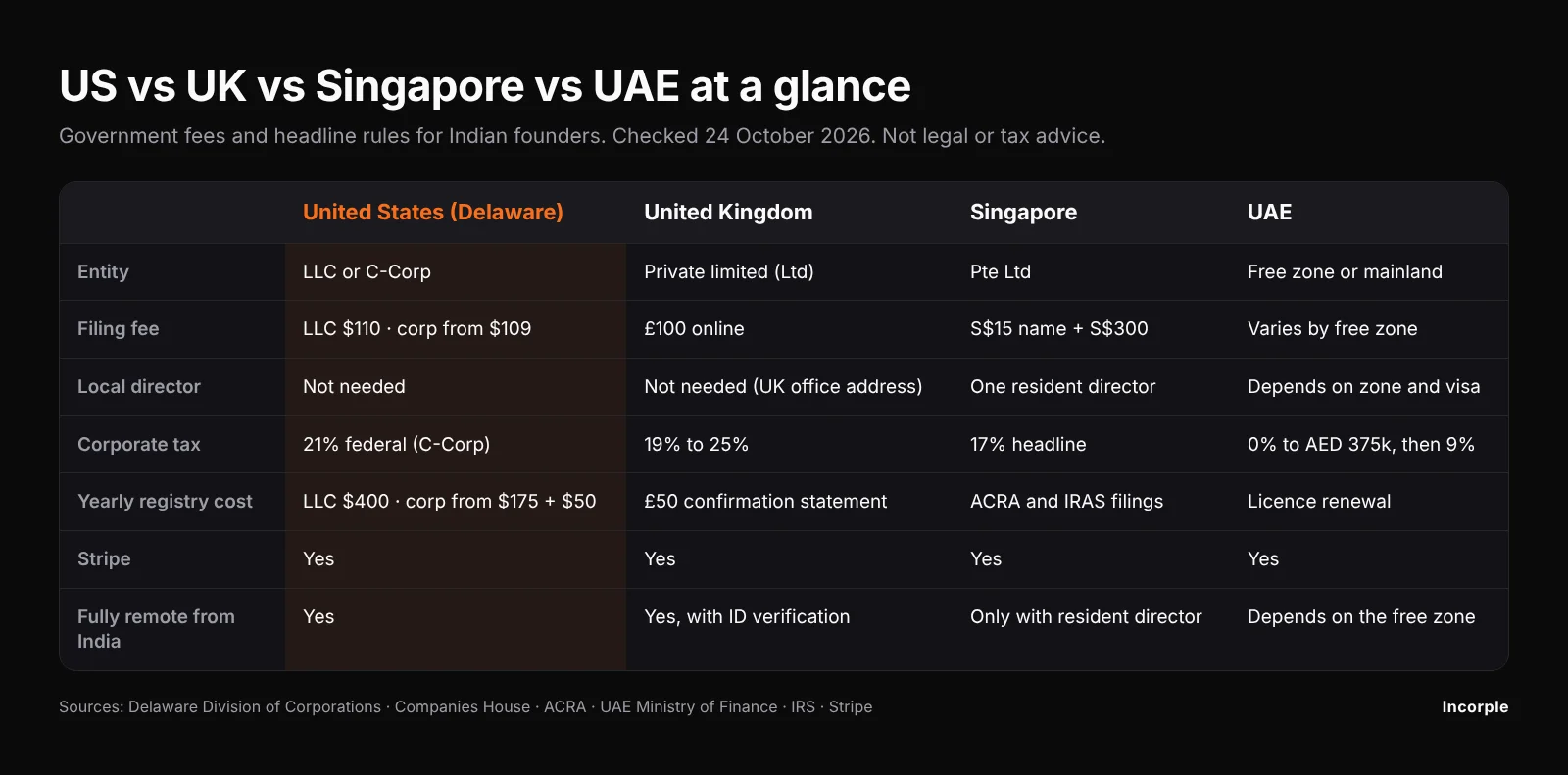
US vs UK vs Singapore vs UAE at a glance
The table shows government fees and headline rules only. It leaves out service providers' fees, registered office or agent costs, accounting and banking charges, which vary by provider.
| United States (Delaware) | United Kingdom | Singapore | UAE | |
|---|---|---|---|---|
| Common entity | LLC or C-Corp | Private limited company (Ltd) | Private limited (Pte Ltd) | Free zone or mainland company |
| Government filing fee | LLC $110, corporation from $109 (Delaware fee schedule) | £100 online (Companies House) | S$15 name + S$300 registration (ACRA) | Set by each free zone or emirate, varies widely |
| Local director needed? | No | No, but a UK registered office address is required (GOV.UK) | Yes, at least one ordinarily resident director (ACRA) | Depends on the free zone and visa |
| Headline corporate tax | 21% federal for C-Corps (26 USC §11). A single-owner LLC is usually taxed through the owner instead | 19% up to £50k profit, 25% above £250k, marginal relief between (GOV.UK) | 17%, with partial exemptions (PwC, Stripe) | 0% up to AED 375,000, 9% above (UAE MoF) |
| Yearly state or registry cost | LLC $400 tax due 1 June. Corporation from $175 tax + $50 report due 1 March (Delaware) | £50 confirmation statement (Companies House) | Annual filings with ACRA and IRAS | Licence renewal with your free zone |
| Stripe available? | Yes (Stripe) | Yes | Yes | Yes |
| Set up from India? | Yes, fully remote | Yes, but each director must verify their identity with Companies House | Only with a resident director | Depends on the free zone and visa rules |
United States
The US is the default for Indian founders selling software or services to American customers. Delaware's filing fee is $110 for an LLC, and corporations start at $109 (Delaware fee schedule).
LLC or C-Corp. An LLC is simpler and suits founders who want to sell and get paid. A C-Corp pays 21% federal tax and is what most US investors expect if you plan to raise money.
Two costs people miss.
- Delaware LLCs pay a $400 annual tax by 1 June (Delaware). Many guides still say $300, which is out of date.
- A single-owner LLC owned by a non-US person must file IRS Form 5472 with a pro forma Form 1120 every year, even with no income. The penalty for missing it is $25,000 (IRS).
No SSN needed for an EIN. Founders without an SSN or ITIN apply for an EIN by phone (international applicants), fax or mail using Form SS-4 (IRS).
This is the one country where we can do it for you. See how Incorple forms your US company.
United Kingdom
The UK is the cheapest serious option for founders selling to UK and European clients. Registering online with Companies House costs £100 (Companies House).
Directors don't have to live in the UK, but the company needs a UK registered office address (GOV.UK). Since 18 November 2025 every director must also verify their identity with Companies House (GOV.UK).
Corporation tax is 19% on profits up to £50,000 and 25% above £250,000, with marginal relief in between (GOV.UK).
Singapore
Singapore gives you regional credibility in Asia, but it is not a fully remote setup. Registration costs S$15 for the name and S$300 to register (ACRA).
The catch is that every company needs at least one director who is ordinarily resident in Singapore. ACRA counts citizens, permanent residents and holders of an Employment Pass, Personalised Employment Pass or ONE Pass (ACRA). Founders living in India usually need a nominee director from a service provider, which is an ongoing cost. You also need a company secretary within six months.
The headline corporate tax rate is 17%, with partial exemptions on the first slices of profit (PwC).
UAE
The UAE suits founders who will genuinely live or operate there. Corporate tax is 0% on taxable income up to AED 375,000 and 9% above that (UAE Ministry of Finance).
Free zone companies can pay 0% on qualifying income, but only with real substance in the free zone, meaning staff, assets and activity there (Federal Tax Authority). A UAE company run entirely from India may not get that benefit, and it can raise the India tax question below.
The India-side rules for every option
Every option above counts as an overseas investment if you live in India. Here is what the rules say. Check your own case with a CA before you send money.
- ODI is allowed only in a real operating business. A resident individual can invest in a foreign company that runs a bona fide business and isn't in financial services. You can't control a foreign company that has its own subsidiary or step-down subsidiary (RBI Overseas Investment Directions). ODI goes through your bank (an authorised dealer), so talk to them first.
- It counts against your LRS limit. Under the Liberalised Remittance Scheme you can send up to USD 250,000 per financial year, April to March (RBI).
- TCS applies above ₹10 lakh. Under section 394 of the Income-tax Act 2025, your bank collects 20% TCS on LRS remittances above ₹10 lakh a year for purposes other than education or medical treatment (Income Tax Department).
- Declare it in your return. Residents with assets outside India report them in Schedule FA of the ITR and can't use ITR-1 (Income Tax Department).
- Watch where decisions are made. A foreign company is treated as resident in India if its place of effective management is in India, meaning key management and commercial decisions are in substance made here (Income Tax Department, section 6). This matters most for a company run day to day from India.
Can you get paid with Stripe in each country?
Yes, in all four. Stripe is available to businesses in the US, UK, Singapore and UAE (Stripe). In India, Stripe is invite-only (Stripe support), which is one reason so many Indian founders set up abroad.
Bank accounts are a separate question. Banks decide who they accept, and remote options change often, so check with the bank before you form the company.
FAQ
What is the best country for an Indian founder to incorporate? It depends on your customers and where you live. US customers, Stripe and US investors point to the US. Asia-focused B2B points to Singapore. UK and EU clients point to the UK. Living in Dubai points to the UAE.
Do I need RBI approval to set up a company abroad? Overseas investment by a resident individual goes through your bank as an authorised dealer, under the RBI's Overseas Investment rules (RBI). Whether anything more is needed depends on your case, so speak to your bank and a CA before you send money.
Can I set up a Singapore company while living in India? Only with a director who is ordinarily resident in Singapore, such as a nominee director from a service provider (ACRA).
Is a UK company cheaper than a US LLC? To register, yes. UK online registration is £100 and a Delaware LLC is $110 plus a $400 yearly tax. But the US LLC also needs a registered agent and a yearly Form 5472, and the UK company needs a registered office and accounts, so compare the full yearly cost.
Does Incorple form companies in the UK, Singapore or UAE? Not today. We form US companies. If you want one of the others, tell us on a call and we'll point you in the right direction.
Not sure which one fits?
Take the Entity Fit Assessment for a quick read on your situation, or book a call and tell us where you want to incorporate. If the US is right, we'll set it up for you.
Not legal or tax advice. Fees and rates checked 24 October 2026. Rules change, so check the linked official page before you act.
Sources
Delaware Division of Corporations fee schedule (revised 1 Aug 2026) and franchise tax page · IRS Instructions for Form 5472 and Form SS-4 · 26 USC §11 · GOV.UK Companies House fees, directors, identity verification, corporation tax rates · ACRA registration, directors and residency requirements · PwC Worldwide Tax Summaries and Stripe (Singapore tax) · UAE Ministry of Finance Cabinet Decision 116 of 2022 · UAE Federal Tax Authority free zone guide · RBI Overseas Investment Directions and LRS Master Direction · Income Tax Department sections 394 and 6, ITR-2 help · Stripe Global and Stripe India support.